
Every one of us lives inside an ongoing internal narrative. A quiet stream of interpretations, assumptions, predictions, and meaning‑making that shapes how we feel and how we move through the world. These stories aren’t random. They’re formed from past experiences, protective patterns, attachment histories, and the beliefs we’ve absorbed over time. And while these stories often begin as attempts to keep us safe, they can also limit us, confuse us, or pull us into emotional spirals of creating stories that don’t reflect reality.
This month, we’re exploring the stories we tell ourselves, not to judge them, but to understand them. When you can recognize the narrative you’re in, you gain the power to shift it.
How Thoughts Shape Feelings
In Cognitive‑Behavioral Therapy (CBT), we talk about the connection between thoughts, feelings, and behaviors. The idea isn’t that thoughts are “good” or “bad,” but that they influence how we interpret the world.
For example: A partner doesn’t respond to a text. The story you might tell yourself is “They’re upset with me,” leading to feelings like anxiety, guilt, or fear. Here is an alternative: A partner doesn’t respond to a text. The story you tell yourself could be “They’re probably busy,” leading to feeling neutral, patient, grounded. Same event. Completely different emotional experience. Your feelings don’t come from the event itself, they come from the meaning your mind assigns to it, stemming from how you think about the event and the story you tell yourself.
Why Our Stories Become Distorted
When we’re stressed, tired, overwhelmed, or triggered, our brain tends to default to familiar narratives. These often fall into predictable patterns known as cognitive distortions. Some common ones include catastrophizing, mind-reading, all-or-nothing thinking, and personalizing.
- Catastrophizing: imagining the worst‑case scenario
- Mind‑reading: assuming you know what someone else is thinking
- All‑or‑nothing thinking: seeing things as entirely good or entirely bad
- Personalizing: assuming something is your fault without evidence
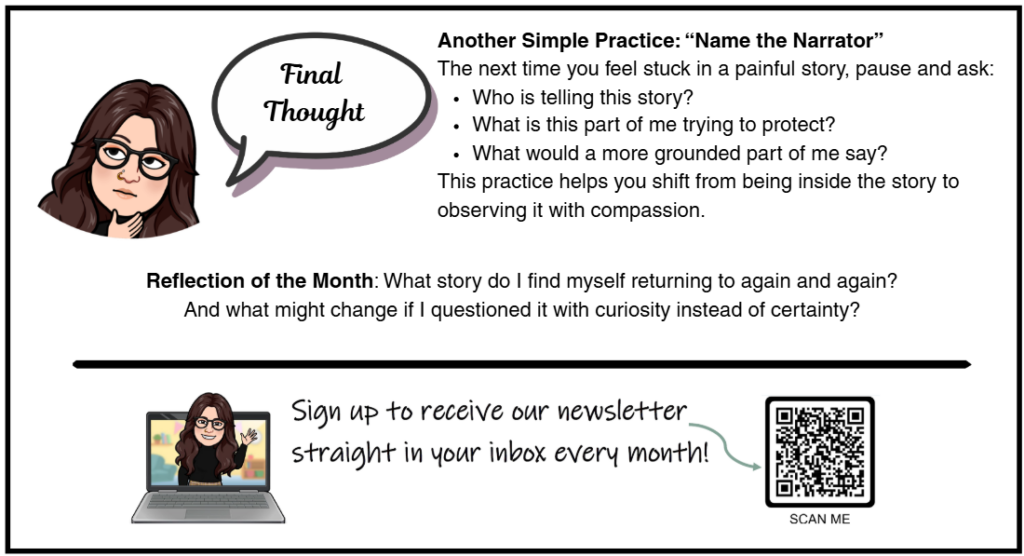
The Inner Narrator
Everyone has an inner narrator. A voice that comments on your experiences, predicts outcomes, and fills in the blanks. Sometimes this narrator is compassionate and wise. Other times, it’s anxious, critical, or shaped by old wounds.
One of the most powerful resilience skills is learning to recognize who is narrating in a given moment. Is it the grounded adult part of you? The scared child part? The perfectionist? The protector? The part that fears abandonment?
When you can identify the narrator, you can respond with more clarity and less reactivity.
A Simple Reframing Practice
Try this three‑step process when you notice a strong emotional reaction:
- Identify the story. What is my mind telling me right now?
- Examine the evidence. What facts support this story? What facts contradict it?
- Create a more balanced alternative. What else might be true?
For example: “My friend hasn’t replied because they’re annoyed with me.” → “I don’t actually know that. They’ve been overwhelmed at work lately.” → “It’s possible they’re busy, and I can check in if I need clarity.”
This isn’t about forcing positivity. It’s about widening the lens.
Jillian Thony, MFT-A, Marriage & Family Therapy Associate
Call/text 907.313.4433