
Happy New Year! Let’s start 2026 by learning about some of the patterns that couples often caught in. These can apply not only to intimate partner relationships but also within family dynamics. Read on to discover if you see these patterns in yourself or loved ones.
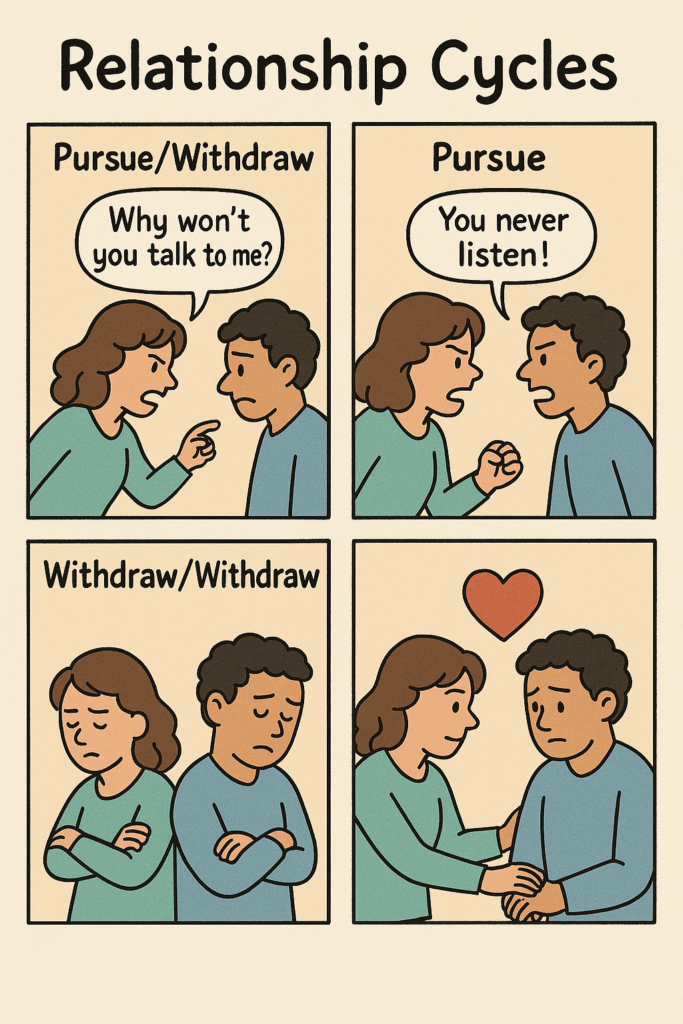
When partners feel unheard, unseen, or emotionally unsafe, they fall into predictable patterns that make perfect sense given their histories, fears, and attachment needs. These patterns aren’t signs of failure; they’re signals. And three of the most common signals seen in relationships are the pursue/withdraw, pursue/pursue, and withdraw/withdraw cycles. This month’s newsletter centers around the idea from Sue Johnson’s Emotionally Focused Therapy that conflict in relationships is not the true enemy, disconnection is.
EFT teaches that these cycles are not the problem, they’re the map. When couples can recognize the dance they’re in, they can slow it down, soften, and reach for each other with vulnerability instead of fear. The goal isn’t to eliminate conflict but to transform it into connection: “I protest because I need you,” “I pull away because I’m scared,” “I go quiet because I don’t know how to reach.”
When partners understand the emotional logic beneath their patterns, they can finally change the music and move together in a way that feels safer, closer, and more connected.

In a pursue/withdraw dynamic, one partner reaches for closeness, clarity, or reassurance. Their reaching may come out as questions, intensity, or protest. The other partner, sensing pressure or fearing they’ll disappoint, retreats to regain emotional footing. Both partners are longing for connection, yet the dance leaves them feeling misunderstood and alone. The pursuer thinks, Why won’t you come closer? The withdrawer wonders, Why am I never enough?
In a pursue/pursue cycle, both partners move toward each other with urgency. Their protests may escalate into raised voices or rapid-fire arguments, but underneath the intensity is a shared fear: Do I matter to you? Will you choose me? This cycle is often fueled by deep longing. Two people fighting hard because the relationship matters so much.
In a withdraw/withdraw pattern, both partners protect themselves by shutting down. The relationship may look peaceful from the outside, but inside, emotional distance grows quietly. Neither partner wants to rock the boat, yet the silence becomes its own kind of disruption. The fear here is often, If I reach, will you turn away?
Reflection Prompt (Individual or Couple)
1. Naming the Cycle
When conflict arises, which cycle do we tend to fall into: pursue/withdraw, pursue/pursue, or withdraw/withdraw? What emotions show up for me in that moment? What emotions do I hide?
2. The Deeper Longing
When I pursue or protest, what am I actually longing for beneath the intensity?
When I withdraw or shut down, what am I protecting myself from?
3. The Story I Tell Myself
What story do I tell myself about my partner’s behavior in our cycle? What story might they be telling themselves about mine?
4. The Attachment Need
What do I need most from my partner when our cycle activates? Comfort, reassurance, space, clarity, softness?
How do I typically communicate that need? How might I express it more vulnerably?
Jillian Thony, MFT-A
Marriage and Family Therapist
akconfluence.com
Call/text 907. 313.4433